
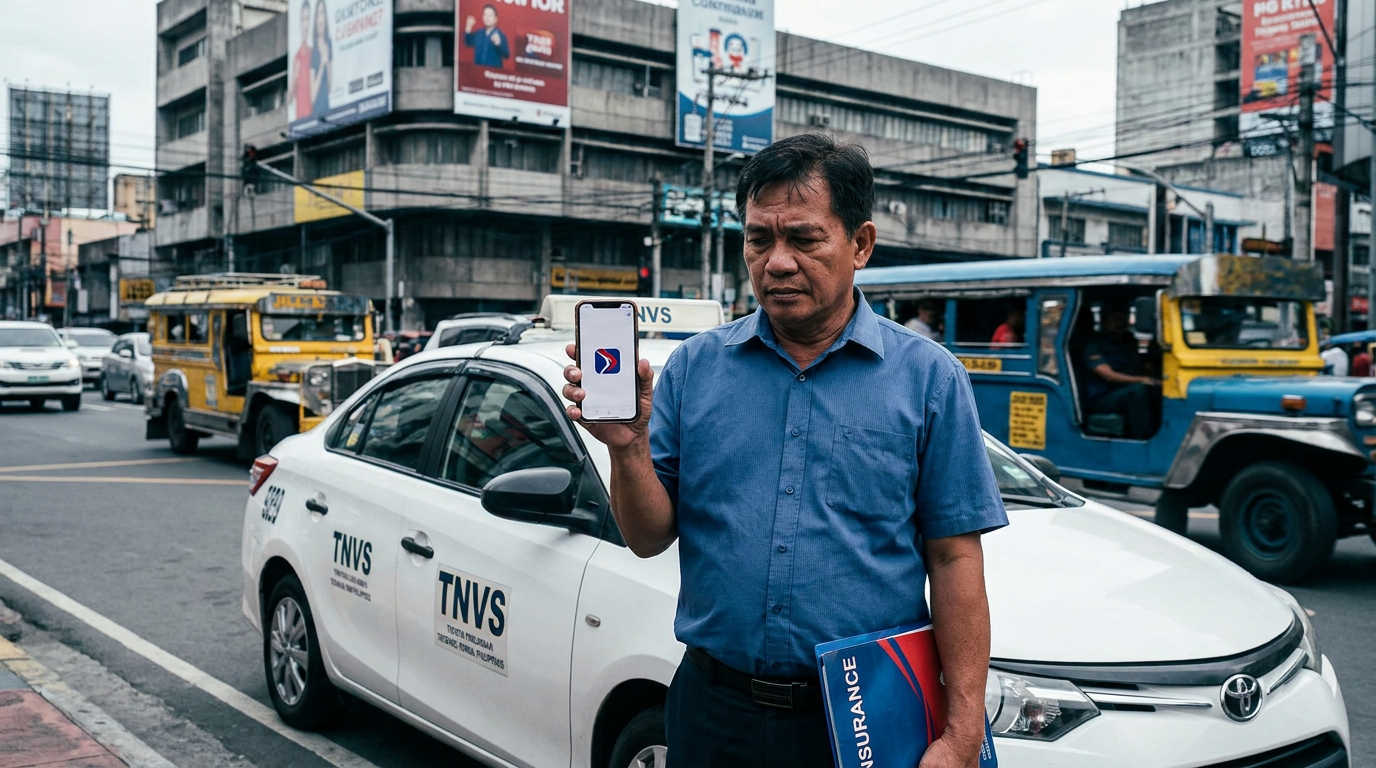
If you drive for Grab, Angkas, Joyride, or any other LTFRB-accredited Transport Network Vehicle Service (TNVS) platform in the Philippines, there is a good chance you have heard the following: "The app covers you while you're driving." It is one of the most widespread and most costly misconceptions among Filipino ride-hailing drivers today.
Platform insurance — the coverage programs offered by Grab, Angkas, and similar companies to their driver-partners — does exist. But it is limited in scope, conditional in application, and was never designed to function as a standalone insurance policy for your vehicle or your livelihood. Many drivers who believed their platform coverage was sufficient have discovered the hard way that it left them exposed precisely when they needed protection most.
This guide breaks down how platform insurance actually works, where it stops, what a proper TNVS Secure insurance policy covers that platform programs do not, and how to structure your coverage correctly so you are never caught in the gap.
What Platform Insurance Actually Is
Platform insurance programs — like Grab's GrabInsure partner coverage or Angkas' driver protection scheme — are group benefit arrangements that Transport Network Companies (TNCs) have set up for their accredited driver-partners. They are not individual insurance policies issued to you personally. You do not receive a policy document in your name, you do not negotiate coverage terms, and you have no direct contractual relationship with the insurer.
These programs typically provide:
- Limited passenger personal accident benefits — a fixed death or disability payout for passengers injured during a covered trip, subject to sub-limits
- Basic driver personal accident benefits — a modest death or disability payment for the driver, often capped at levels well below actual income replacement needs
- Third-party liability for specific trip phases — coverage that activates only when a booking is accepted and a passenger is onboard, and terminates when the trip ends
What platform insurance almost never covers: damage to your own vehicle, theft of your vehicle, Acts of Nature damage, incidents that occur outside of the platform's defined "active trip" window, or any scenario where the platform determines you were not in compliance with its operational policies at the time of the incident.
Think of platform insurance as a thin safety net, not a comprehensive one. It catches a narrow set of incidents during a narrow window of your operational day. Everything outside that window is your problem — unless you have your own policy in place.
The Three Coverage Phases — and Where the Gap Opens
To understand the gap, you need to understand how a typical TNVS driver's operational day is divided into phases — and how coverage changes (or disappears) across each one.
Phase 1: App Open, Waiting for a Booking
You have logged into your ride-hailing app and are available to accept trips — but no booking has been matched yet. You might be sitting in a queue near a mall, driving around a residential area, or parked near a transport hub waiting for a ping.
Coverage status: In most platform insurance programs, this phase is either uncovered or minimally covered. The platform considers you "online but not on a trip" — and many programs do not extend liability or accident benefits during this window. Your private car insurance is also void because the vehicle is in commercial TNVS service. This is one of the most dangerous coverage gaps for Filipino ride-hailing drivers.
Phase 2: Booking Accepted, En Route to Passenger
A booking has been matched and confirmed. You are driving toward the pickup location but the passenger has not yet entered the vehicle.
Coverage status: Some platform programs extend partial coverage here — typically basic third-party liability only. However, coverage limits are often lower than when a passenger is aboard, and own-vehicle damage may still be excluded. The coverage window in this phase exists only from the moment of booking confirmation to pickup — a matter of minutes — which means accident exposure is real but protection remains thin.
Phase 3: Passenger Onboard, En Route to Destination
This is the phase where platform insurance is most active. A paying passenger is in your vehicle and the trip is in progress from pickup to drop-off.
Coverage status: Platform programs typically provide their broadest coverage here — passenger accident benefits, driver accident benefits, and third-party liability. However, own vehicle damage and theft are still commonly excluded, Acts of Nature are rarely covered, and benefit caps may be insufficient for serious incidents. This is also the only phase where platform coverage is reasonably dependable.
The takeaway: even in the best-case scenario, platform insurance covers you meaningfully only during Phase 3 — the portion of your working day when a passenger is literally onboard. Every other minute you spend on the road as a TNVS driver, your coverage situation is compromised, absent, or subject to dispute.
What a Proper TNVS Secure Policy Covers
A dedicated TNVS Secure insurance policy — issued individually to you as the vehicle owner and TNVS operator — is not phase-dependent. It recognizes your vehicle's commercial use classification and provides protection that applies throughout your operational period, not just during moments defined by a platform algorithm.
A comprehensive TNVS Secure policy covers:
- Own Damage and Theft (ODDS) — repair or replacement of your vehicle after an accident or theft, whether a passenger was aboard or not at the time of the incident
- Third-Party Liability (TPL) and CTPL — bodily injury and property damage coverage for other road users you may injure or affect, covering all phases of your operational day
- Passenger Liability — medical and hospitalization benefits for passengers injured in your vehicle, typically with higher benefit limits than platform programs
- Acts of Nature (AON) — typhoon, flood, storm surge, and earthquake damage — a non-negotiable coverage component in the Philippines, which experiences an average of 20 typhoons per year
- Driver Personal Accident (add-on) — compensation for your own injuries, disability, or death while operating the vehicle, with benefit levels you choose rather than minimums set by a platform
Critically, a TNVS Secure policy is issued in your name, with documented coverage terms you can read, dispute, and verify. If a claim is denied, you have legal recourse under Philippine insurance law and the oversight of the Insurance Commission. Platform insurance programs do not offer the same structured accountability.
Four Dangerous Misconceptions About TNVS Coverage
Misconception 1: "Grab covers me while I'm driving."
Only partially, and only during specific moments. Grab's partner insurance activates at defined trip phases and covers defined benefit types. The rest of your operational day is yours to insure. The fact that you are logged into the Grab app does not mean Grab's insurance is active and protecting your vehicle from every risk.
Misconception 2: "CTPL is enough."
CTPL is the minimum statutory requirement — it covers third-party bodily injury and death, with limits that have not kept pace with actual medical costs in the Philippines. It does not cover your vehicle, third-party property, your passengers, or yourself. For a TNVS operator who covers hundreds of kilometres weekly, CTPL alone is financially reckless.
Misconception 3: "My private car insurance covers me on TNVS trips."
This is a complete misunderstanding. Standard private motor car insurance policies in the Philippines explicitly exclude coverage when the vehicle is used for hire, reward, or commercial purposes. The moment you accept a paid booking from a passenger through a ride-hailing platform, your private policy's protection is voided. Filing a TNVS-related claim under a private car policy is grounds for claim denial — regardless of fault.
Misconception 4: "Platform insurance and CTPL together are sufficient."
This combination leaves your vehicle uninsured for own damage and theft, leaves you unprotected during Phase 1 and 2 of your operational day, provides no Acts of Nature coverage, and gives you no structured policy document with your own legal rights as the insured. It is not a substitute for a proper TNVS Secure policy.
How to Layer Your Coverage Correctly
The correct coverage structure for a Filipino TNVS operator works in layers — each with a specific purpose:
| Coverage Layer | Purpose | Mandatory? |
|---|---|---|
| CTPL | Statutory third-party bodily injury baseline | Yes (LTO/LTFRB) |
| TNVS Secure Comprehensive Policy | Full vehicle, passenger, and liability protection for commercial use | Yes (LTFRB franchise) |
| Acts of Nature Add-on | Protection against typhoons, floods, and storm surge | Strongly recommended |
| Driver Personal Accident Add-on | Income replacement and medical coverage for yourself | Strongly recommended |
| Platform Insurance (Grab/Angkas) | Supplementary benefits during active trip phases only | Supplementary |
The most important shift in perspective: platform insurance is the supplement, not the foundation. Your TNVS Secure policy is the foundation. Platform programs add limited value on top of a solid base — but they cannot function as a base themselves.
Choosing the Right TNVS Secure Policy
Not all TNVS Secure products in the Philippine market are structured the same way. Key factors to compare when selecting a policy include:
- Own Damage coverage limits relative to your vehicle's current market value
- Third-party property damage limits — ₱100,000 is typically insufficient in urban Metro Manila scenarios
- Passenger liability per-person and per-accident sub-limits
- Acts of Nature inclusion (not always automatic — verify this)
- Whether driver personal accident is bundled or an add-on
- Claims processing reputation and service quality of the issuing insurance company
Working with an independent insurance agency — one that compares TNVS Secure products across multiple Insurance Commission-accredited providers — gives you objective guidance on these factors rather than the limited perspective of a single insurer's tied agent.
Before your next shift: If you are unsure whether your current coverage has a gap during Phase 1 or Phase 2 of your operational day, review your policy documents now. Look for the words "hire and reward" or "commercial use" in the exclusions section. If your current policy is a standard private car policy, or if you cannot find documented TNVS Secure coverage in your name, you are operating with an uninsured gap every day.
Closing the Gap Before an Accident Does It for You
The platform insurance question is not about distrust of Grab, Angkas, or any other TNVS company. These programs provide real value as supplementary coverage during active trip phases. The question is whether Filipino ride-hailing drivers understand what those programs are designed to do — and, more importantly, what they are not.
A proper TNVS Secure policy fills in every phase of your operational day: the time you spend waiting for a booking, en route to a passenger, carrying a passenger, and driving home after your last trip. It protects the vehicle that is your primary income-generating asset against damage, theft, and natural disaster. It gives you documented rights under Philippine insurance law.
The cost of a comprehensive TNVS Secure policy is predictable and manageable. The cost of discovering your coverage gap in the aftermath of a serious accident is not. Close that gap now — before the next trip, not after the next incident.
Get a Free Quote Today
Ready to protect what matters most? Our insurance experts are here to help you find the right TNVS Secure coverage at the best price. OneNetworx Insurance Agency is an independent, non-tied agency — we compare options from multiple top Philippine insurers so you get unbiased guidance, not a single-company pitch.
🌐 www.onenetworxinsurance.com
About the Author
Angelo Villamejor is a former financial wealth branch manager at a top Philippine life insurance company and a GAMA Awardee, with nearly three decades of experience spanning insurance brokerage, bancassurance, non-life and life insurance leadership. He leads OneNetworx Insurance Agency with a focus on giving Filipino families and businesses unbiased, expert guidance to find coverage that holds up when it matters most.