
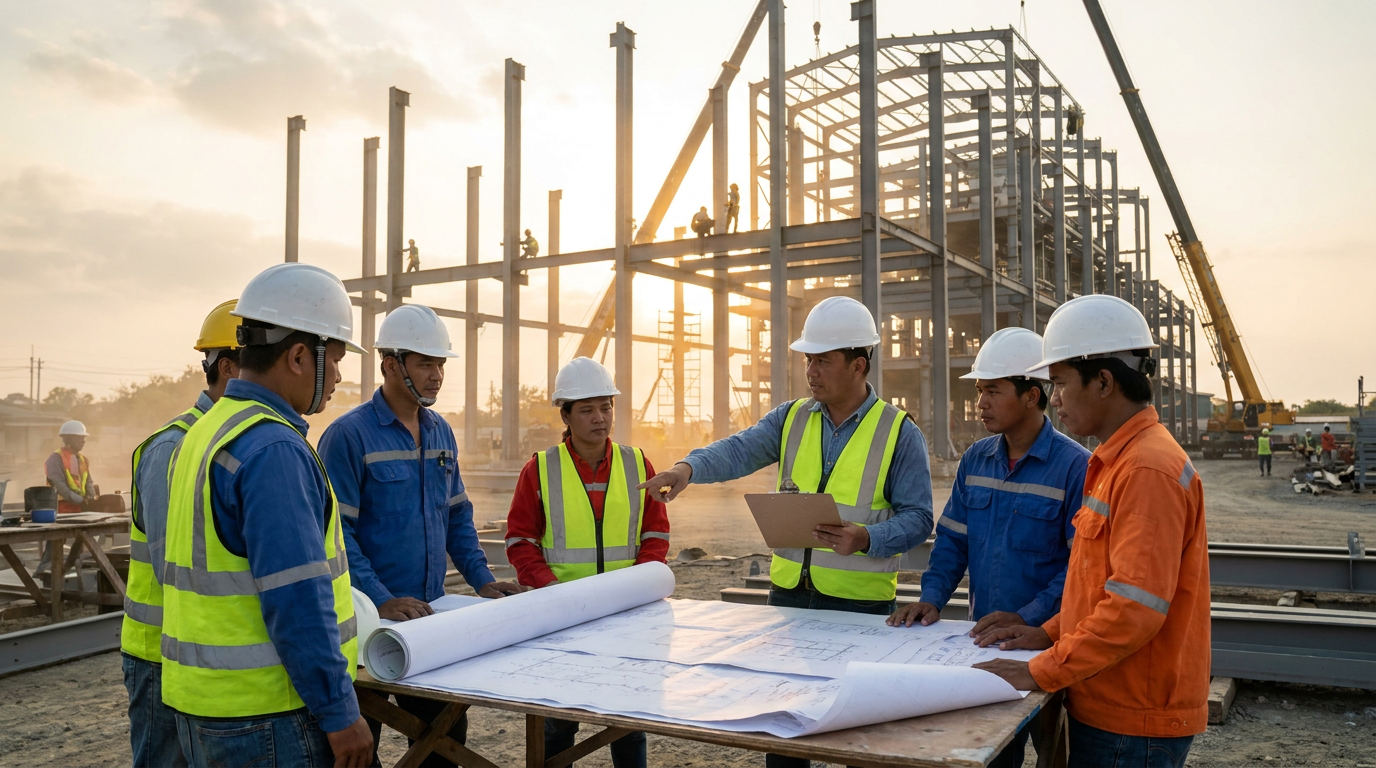
A crane operator in Laguna lifts a massive industrial compressor into position. The rigging slips. The equipment crashes to the ground. Repair cost: ₱4.8 million. Timeline: delayed by six weeks. Third-party property damaged: another ₱600,000. The contractor had general liability insurance — but it didn't cover equipment under erection. The project owner had property insurance — but it only applied to completed, operational assets.
This scenario plays out on Philippine project sites more often than anyone wants to admit. And the gap it exposes — the uninsured period between equipment arriving at a site and being handed over as a completed installation — is precisely what Erection All Risks (EAR) Insurance is designed to close.
If you are a contractor, project owner, developer, or engineer managing any kind of mechanical, electrical, or structural installation project in the Philippines, this guide is for you.
What is Erection All Risks Insurance?
Erection All Risks (EAR) Insurance is a specialized form of engineering insurance that provides comprehensive coverage for the physical loss or damage to machinery, plant, equipment, and steel structures during their installation, testing, and commissioning phases. It also typically includes Third Party Liability (TPL) coverage for bodily injury or property damage caused to others during the erection works.
EAR insurance is distinct from Contractor's All Risks (CAR) insurance, which covers civil engineering construction like buildings, roads, and bridges. While CAR covers the pouring of concrete and the laying of structural foundations, EAR covers what goes inside: the industrial machinery, mechanical and electrical systems, and steel structures being assembled and commissioned.
Key distinction: EAR vs. CAR Insurance
- CAR Insurance: Civil construction — buildings, roads, dams, bridges, earthworks
- EAR Insurance: Mechanical/electrical/steel installation — industrial machinery, power plants, pipelines, manufacturing equipment, transmission towers
Many large Philippine infrastructure projects require both — CAR for the civil works phase and EAR for the mechanical and electrical installation phase.
Coverage under an EAR policy begins the moment insured items arrive at the project site (typically from unloading) and continues through installation, testing, and commissioning — until the project is formally handed over to the owner.
What Does EAR Insurance Cover in the Philippines?
A comprehensive EAR policy in the Philippine market typically covers two main sections, with optional extensions available depending on the nature of the project.
Section I — Material Damage to the Works
This covers accidental physical loss or damage to the equipment, machinery, or structures being erected. Covered causes typically include:
- Fire and explosion — including welding accidents and fuel-related fires common on construction sites
- Collapse and falling objects — crane failures, rigging accidents, and structural collapses during erection
- Theft and vandalism — particularly relevant for remote project sites with limited security
- Natural calamities — typhoon, flood, earthquake, volcanic eruption (available as optional extensions in the Philippine context)
- Errors during erection — mechanical or electrical failures that occur during testing and commissioning due to incorrect assembly or operational error
- Accidental damage during installation — any sudden, unforeseen physical damage that was not the result of deliberate action or gross negligence
Section II — Third Party Liability
This covers the insured's legal liability to third parties for:
- Bodily injury — injury or death of third parties (not employees) caused by the erection works
- Property damage — accidental damage to neighboring property, structures, utilities, or infrastructure caused by erection activities
On a busy Philippine industrial site or urban construction project, third-party liability exposure can be substantial. A falling object that damages an adjacent building, or an erection vehicle that ruptures a buried utility line, can generate claims running into millions of pesos.
Optional Extensions Worth Considering
- 🔹Surrounding property: Covers accidental damage to existing property belonging to or in the custody of the project owner
- 🔹Maintenance period coverage: Extends protection for 12 months after project handover, covering defects originating during the erection phase discovered post-completion
- 🔹Express freight and overtime: Covers the additional cost of airfreighting replacement parts and paying overtime labor to expedite repairs — reducing project delays after a loss
- 🔹Advance loss of profits (ALOP): Compensates the project owner for lost revenue caused by delayed project completion following a covered loss — a critical extension for revenue-generating projects like power plants and factories
- 🔹Employee's tools and equipment: Covers loss of or damage to tools and equipment belonging to employees or subcontractors brought to the site
Who Needs EAR Insurance in the Philippines?
EAR insurance is essential for any project that involves the installation, assembly, or commissioning of industrial or mechanical systems. In the Philippine context, the following types of projects and organizations routinely require EAR coverage:
Manufacturing and Industrial Facilities
Food processing plants, textile manufacturers, electronics assembly facilities, pharmaceutical plants, and beverage producers installing new production lines or upgrading machinery need EAR coverage for the installation phase.
Power Generation and Energy Projects
Solar farm installations, diesel power plant erections, transmission tower assemblies, and substation construction all involve high-value mechanical and electrical equipment with significant erection risk. Many lenders and project financiers require EAR insurance as a condition of project financing.
Real Estate and Commercial Development
Installation of elevators, escalators, HVAC systems, building management systems (BMS), large generators, and water treatment facilities in commercial buildings, malls, and mixed-use developments typically requires EAR coverage for the installation phase.
Telecommunications Infrastructure
With the ongoing rollout of mobile towers, fiber optic networks, and data center infrastructure across the Philippines, EAR coverage is relevant for telecommunications contractors installing equipment at height and in remote locations.
Steel Structure Fabrication and Assembly
Structural steel frameworks for warehouses, bridges, storage tanks, and industrial platforms being fabricated and erected on-site are covered under EAR policies as "steel structures in the course of erection."
Contractual requirement alert: Major Philippine project owners — government agencies (DPWH, NEA, DOE), large corporations, and foreign-funded development projects — frequently require EAR insurance as a mandatory contract condition before work begins. Failure to secure EAR coverage before mobilization can result in contract suspension or termination.
Common EAR Insurance Exclusions: What Filipino Contractors Must Watch Out For
Understanding exclusions is just as important as understanding coverage. Philippine EAR policies typically exclude the following, and overlooking them leads to unpleasant surprises at claims time:
- Pre-existing defects known before the project: Damage attributable to a manufacturer's defect that was known or discoverable before installation began is not covered. Conduct equipment inspection and document the pre-installation condition of all major items.
- Normal wear and tear: EAR insurance covers sudden and unforeseen damage, not gradual deterioration or degradation from continuous use during testing.
- Willful negligence and deliberate acts: Damage resulting from the deliberate misuse of equipment, or gross negligence by the insured, is excluded. Standard (non-gross) negligence is typically covered.
- Design defect: EAR policies generally exclude the cost of rectifying the defective design itself — though they cover other damage resulting from the design defect.
- Consequential loss without extension: Loss of profit, penalty clauses, or project delay costs are excluded unless an ALOP/advance profits extension is specifically purchased.
- War, terrorism, and nuclear risk: Standard exclusions across all engineering insurance lines in the Philippines.
Five Practical Tips for Securing EAR Insurance in the Philippines
Secure coverage before mobilization, not after
EAR insurance must be in place before the first piece of equipment arrives on-site. Coverage that begins after mobilization — or after an incident has occurred — is void. This seems obvious, but project timeline pressures frequently cause this to be deferred until it's too late.
Insure the full erected value, not just the equipment cost
The Sum Insured for Section I should reflect the total erected value of the project — equipment, installation labor, freight, and customs duties. Insuring only the equipment purchase cost leads to underinsurance and proportional claim deductions. This is one of the most common and expensive mistakes in Philippine EAR placements.
Cover all parties with an interest in the project
EAR policies can be written to cover multiple named insureds: the project owner, main contractor, and subcontractors. A single project policy covering all parties avoids gaps and disputes over whose policy responds to a claim. Confirm that your policy structure covers the parties as your contract requires.
Request natural catastrophe extensions for Philippine conditions
The Philippines sits at the intersection of the Pacific typhoon belt and the Pacific Ring of Fire. Standard EAR policies may not automatically cover typhoon, flood, or earthquake damage. For projects in typhoon-prone areas (which is most of the country) or in high-seismic zones (much of Luzon, the Visayas, and Mindanao), explicitly request these extensions and confirm they are endorsed onto your policy.
Compare terms from multiple providers, not just one
EAR insurance terms, deductibles, exclusion treatments, and premium rates vary significantly among Philippine non-life insurers. Key differences include: treatment of electrical testing failures, scope of TPL coverage, inclusion or exclusion of natural catastrophes, and availability of ALOP extensions. Working with an independent insurance agency that has access to multiple accredited providers — rather than a tied agent — ensures you see a genuine comparison rather than a single take-it-or-leave-it offer.
- ✅Confirm coverage begins from unloading at site, not just from installation start
- ✅Verify the maintenance period extension is included — post-handover defects can be as costly as installation-phase damage
- ✅Check whether the TPL limit is adequate — in urban Philippine sites, third-party exposure can be disproportionately large
- ✅Ensure your EAR policy and CAR policy (if applicable) are coordinated — overlapping or conflicting coverage is both inefficient and legally risky
- ✅Document equipment condition on arrival at site — photographs and a pre-installation inspection report protect both parties if a damage claim arises
Get a Free Quote Today
Ready to protect what matters most? Our insurance experts are here to help you find the right Erection All Risks Insurance coverage at the best price. OneNetworx Insurance Agency compares options from multiple top Philippine non-life insurers — so your installation project is fully protected from arrival to handover.
🌐 www.onenetworxinsurance.com
About the Author
Angelo Villamejor is a former financial wealth branch manager at a top Philippine life insurance company and a GAMA Awardee, with nearly three decades of experience spanning insurance brokerage, bancassurance, non-life and life insurance leadership. He leads OneNetworx Insurance Agency with a focus on giving Filipino families and businesses unbiased, expert guidance to find coverage that holds up when it matters most.