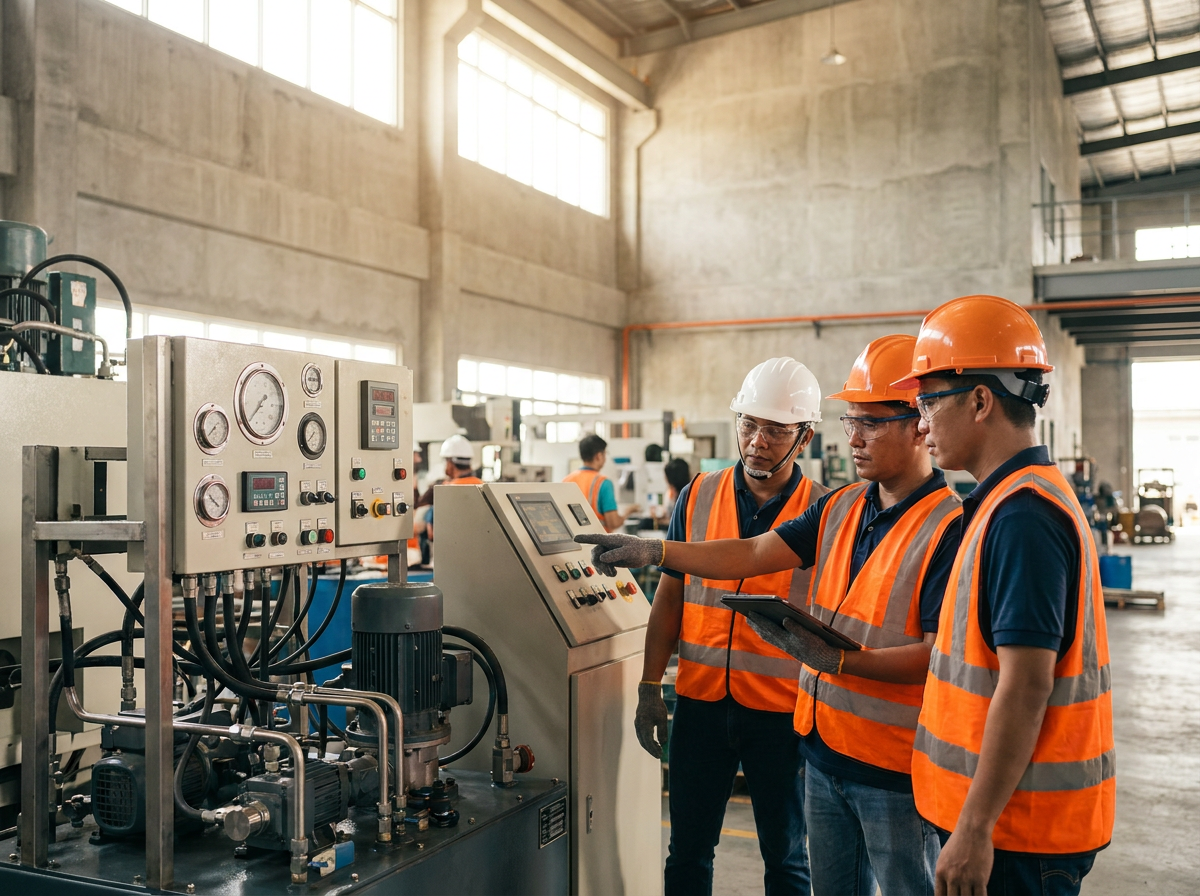
A critical piece of industrial equipment breaks down without warning. Production halts. Repair technicians are unavailable for days. Emergency parts must be sourced from abroad. Within a week, your business has lost orders, disappointed clients, and incurred repair costs that were nowhere in the budget.
For thousands of Philippine manufacturers, food processors, cold chain operators, and industrial businesses, this scenario is not hypothetical — it happens regularly. And in most cases, the business owner discovers the painful truth only after the breakdown: their fire insurance policy does not cover machinery failure.
Machinery Breakdown Insurance is one of the most misunderstood and most underutilized lines of non-life insurance in the Philippines. This guide explains exactly what it covers, why your existing property policies leave a critical gap, which Philippine businesses need it most, and how to make sure your coverage will actually respond when a breakdown occurs.
What Machinery Breakdown Insurance Actually Covers
Machinery Breakdown Insurance — sometimes called Equipment Breakdown Insurance — covers sudden and unforeseen physical damage to mechanical and electrical machinery arising from internal causes. This is the critical distinction: it covers damage that originates from within the equipment itself, not from an external event like a fire or flood.
Covered causes of loss under a standard Philippine machinery breakdown policy typically include:
- Electrical short circuits and burnout — sudden failure of motors, generators, transformers, and control panels due to electrical faults
- Mechanical failure — breakage of gears, shafts, bearings, and other mechanical components due to metal fatigue, vibration, or operational stress
- Operator error and negligence — accidental damage caused by an employee operating equipment incorrectly, including lubricant failure and foreign object ingestion
- Design or manufacturing defects — latent defects in the original manufacture or assembly that manifest as damage during normal operation
- Centrifugal force failures — damage from excessive speed causing components to fracture or separate, common in industrial pumps and centrifuges
- Overpressure in hydraulic systems — damage resulting from pressure surges in hydraulic or pneumatic equipment
Coverage typically extends to the cost of repairing or replacing damaged components, the cost of dismantling and reassembly, and in some policies, expediting expenses — the additional cost of sourcing emergency parts faster than normal to minimize production downtime.
What is NOT covered: Machinery Breakdown Insurance does not cover normal wear and tear, gradual deterioration, corrosion, or maintenance costs — these are considered predictable operating expenses, not insurable risks. External causes of damage (fire, typhoon, flood, theft) remain covered under your property insurance. The two policies are designed to work together, not replace each other.
Why Fire Insurance Is Not Enough: Closing the Gap in Your Coverage
This is the coverage gap that catches Filipino business owners off guard. Many assume that a comprehensive fire and allied perils policy — which typically covers fire, lightning, earthquake, flood, typhoon, and explosion — covers all the risks their machinery faces. It does not.
A standard Philippine fire insurance policy covers damage to machinery caused by an external insured peril: if a fire breaks out and destroys your production line, your fire policy pays. But if your production line motor burns out from an internal electrical fault, or a bearing fails and seizes your main shaft — events with no external cause — your fire policy is silent. You bear the full cost of repair or replacement out of pocket.
Scenario A: A garment factory in Bulacan experiences a fire in the production area. Industrial sewing machines are destroyed. The fire insurance policy responds and covers the replacement cost of the machines. ✅
Scenario B: The same factory's industrial compressor suffers a catastrophic internal bearing failure during operation. The repair cost is ₱480,000. The fire insurance policy does not cover machinery breakdown. Without Machinery Breakdown Insurance, the factory owner pays in full. ❌
Scenario C: A food processing plant in Central Luzon has a refrigeration compressor fail due to a refrigerant leak caused by a material defect. The compressor is destroyed, and ₱2.1 million worth of frozen inventory spoils. Machinery Breakdown Insurance with a Deterioration of Stocks extension responds to both losses. ✅
The pattern is clear: fire and property insurance covers what happens to your machinery from the outside. Machinery Breakdown Insurance covers what happens from the inside. A business that has only fire insurance has covered roughly half its machinery risk.
Which Philippine Businesses Need Machinery Breakdown Insurance Most?
While any business that relies on mechanical or electrical equipment benefits from this coverage, certain sectors face significantly higher exposure to machinery breakdown risk in the Philippine context.
Manufacturing and Industrial Production
Philippine manufacturers — from garments and electronics assembly to furniture, food processing, and chemicals — rely on production machinery that, if it fails, stops the entire line. A single motor or compressor failure can halt operations for days or weeks while parts are sourced, costing far more in lost production than the repair itself. Machinery Breakdown Insurance is essential for any business where equipment uptime is directly linked to revenue.
Cold Chain and Refrigerated Storage
For cold storage operators, supermarkets, seafood exporters, dairy processors, and pharmaceutical distributors, refrigeration system failure is an existential risk. The combination of equipment repair cost and the value of spoiled perishable inventory can easily run into the millions of pesos. A Machinery Breakdown policy with a Deterioration of Stocks (DOS) extension — which covers the value of perishable inventory lost due to refrigeration failure — is a critical safeguard for these businesses.
Hospitals and Medical Facilities
Philippine hospitals and diagnostic centers operate imaging equipment — CT scanners, MRI machines, X-ray systems, and ultrasound units — that can cost tens of millions of pesos to replace and require specialized technicians for repair. A breakdown of diagnostic imaging equipment not only incurs significant repair costs but disrupts patient services and revenue. Electronic Equipment Insurance, which is closely related to Machinery Breakdown Insurance but specifically designed for electronic systems, is essential for medical facilities.
Power Generation and Utilities
Generators, turbines, transformers, and switchgear used in captive power generation, distribution utilities, and backup power systems represent high-value assets with significant breakdown exposure. Failure of a power transformer or generating set can have cascading effects on connected operations and impose large repair costs.
Printing and Publishing
High-speed printing presses, bindery equipment, and digital printing systems are expensive assets prone to mechanical failure under the high-cycle demands of commercial printing. A press failure during a major production run can result in both repair costs and significant consequential losses from missed client deadlines and reprinting costs.
The Philippine power context: Voltage fluctuations, power interruptions, and unstable power supply remain common challenges for Philippine businesses outside Metro Manila. These electrical irregularities accelerate wear on motors, control panels, and sensitive electronic equipment — increasing the frequency and severity of machinery breakdown events. Philippine businesses in areas with unreliable power supply face a higher-than-average machinery breakdown risk profile.
Practical Guidance: How to Get Machinery Breakdown Coverage That Actually Works
Securing Machinery Breakdown Insurance that responds reliably at claims time requires attention to a few key factors. Here is what Philippine business owners and risk managers should know before purchasing a policy.
Declare All Insured Items Accurately
Machinery Breakdown policies are itemized — each piece of equipment should be listed with its make, model, year of manufacture, and insured value. Under-declaring equipment values or omitting machinery from the schedule creates coverage gaps that only become apparent at claims time. Work with your insurance advisor to conduct a proper equipment inventory before binding coverage.
Understand the Basis of Indemnity
Philippine machinery breakdown policies can be written on a repair cost basis or on a replacement value basis for total losses. For critical production equipment, replacement value coverage is preferable — ensuring that if a machine is beyond repair, you receive the cost of a new replacement rather than a depreciated value. Confirm the basis of indemnity with your insurer before finalizing the policy.
Consider Business Interruption Extensions
For many Philippine manufacturers, the repair cost of a broken machine is secondary to the loss of production during the repair period. Machinery Breakdown Business Interruption (MBBI) coverage — sometimes written as a separate policy or extension — compensates for lost gross profit during the period when the insured machinery is being repaired or replaced following a covered breakdown. This extension is particularly valuable for businesses where a single machine is the production bottleneck.
Maintain Proper Service Records
Machinery Breakdown Insurance covers sudden and unforeseen damage — not damage caused by neglect or lack of maintenance. Philippine insurers typically require that insured equipment is properly maintained and serviced in accordance with the manufacturer's recommendations. Maintaining service records is both a policy requirement and a practical necessity for ensuring that claims are not disputed on the grounds of inadequate maintenance.
Compare Policies Across Multiple Providers
Coverage terms, exclusions, deductibles, and premium rates for Machinery Breakdown Insurance vary significantly between Philippine non-life insurers. Key differences include: the scope of covered causes of breakdown, the treatment of electrical damage, the availability of Deterioration of Stocks or Business Interruption extensions, and the expediting expenses provision. An independent insurance advisor who can compare terms across multiple Insurance Commission-accredited providers — rather than a tied agent limited to one company's products — is best positioned to identify the policy that genuinely fits your risk profile.
- ✅Confirm coverage extends to electrical damage and operator error — not all policies include these automatically
- ✅Check whether the deductible (excess) is expressed as a fixed amount or a percentage of the claim — percentage deductibles can be very large on high-value equipment losses
- ✅Ask specifically about coverage for voltage fluctuation damage if your location experiences unstable power supply
- ✅Ensure your fire insurance and machinery breakdown policies are coordinated to avoid gaps or overlap at the boundary of coverage
- ✅Review the policy annually and update insured values — equipment values and replacement costs change over time
Get a Free Quote Today
Ready to protect what matters most? Our insurance experts are here to help you find the right Machinery Breakdown Insurance coverage at the best price. OneNetworx Insurance Agency compares options from multiple top Philippine non-life insurers — so your operations stay protected when equipment fails.
🌐 www.onenetworxinsurance.com
About the Author
Angelo Villamejor is a former financial wealth branch manager at a top Philippine life insurance company and a GAMA Awardee, with nearly three decades of experience spanning insurance brokerage, bancassurance, non-life and life insurance leadership. He leads OneNetworx Insurance Agency with a focus on giving Filipino families and businesses unbiased, expert guidance to find coverage that holds up when it matters most.