
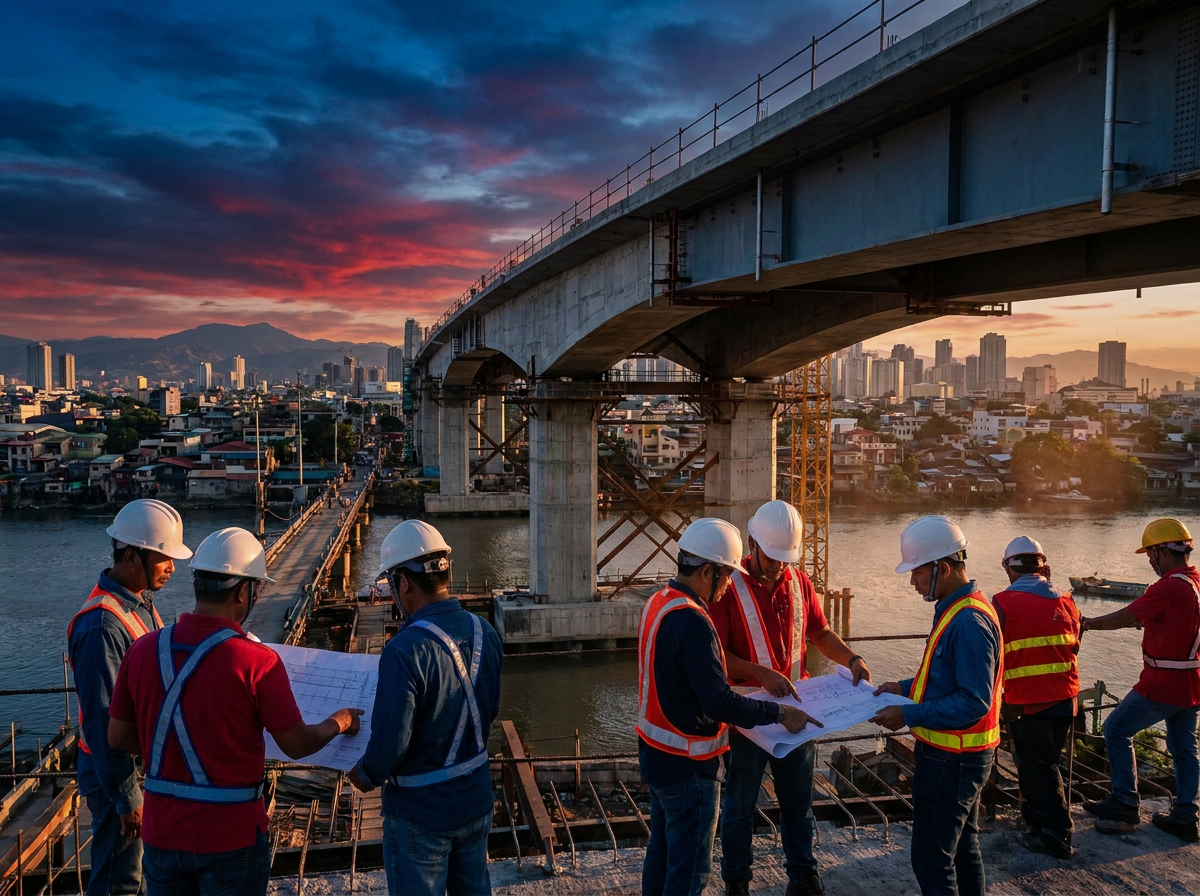
The Philippines is in the middle of one of the most ambitious infrastructure expansions in its history. From the Build Better More program to private real estate development across Metro Manila, Visayas, and Mindanao, construction and engineering activity has never been more intense. But with large-scale projects come large-scale risks — and many Filipino contractors, developers, and project owners remain dangerously underprotected because they do not fully understand what Engineering Insurance is, what it covers, and why it is not optional.
Engineering Insurance is a specialized category of non-life insurance designed to protect construction and infrastructure projects, heavy machinery, and the third parties affected by engineering operations. It is distinct from ordinary property or fire insurance — it is built specifically for the dynamic, high-risk environment of construction and engineering work.
This guide explains the key lines of Engineering Insurance available in the Philippines, who needs each type, how coverage works in practice, and the most common misconceptions that leave Filipino project stakeholders exposed.
The Main Lines of Engineering Insurance in the Philippines
Engineering Insurance is not a single policy — it is a family of related products, each designed to address specific risks that arise in construction, infrastructure, and industrial operations. The four most important lines in the Philippine market are as follows.
Contractor's All Risk (CAR) Insurance
Contractor's All Risk Insurance is the most widely used engineering insurance product in the Philippines. It provides comprehensive protection for civil engineering and building construction projects against accidental physical loss or damage during the construction period. A CAR policy covers the contract works themselves — materials, temporary structures, construction equipment already in place — as well as third-party bodily injury and property damage arising from construction activities.
In practical Philippine terms, this means coverage responds to events such as typhoon damage to a partially completed structure, collapse of scaffolding during construction, fire or flooding at a building site, theft of construction materials on-site, and accidental damage to an adjacent property caused by excavation or heavy equipment operation. Typhoon risk alone — given the average of 20 tropical cyclones that enter the Philippine area of responsibility each year — makes CAR Insurance a critical requirement for any outdoor construction project.
CAR policies in the Philippines are typically structured with two sections: Section I covering physical loss or damage to the contract works and construction plant and equipment, and Section II covering third-party liability for bodily injury and property damage. Project owners and main contractors may be named as insured parties, and the policy period corresponds to the agreed construction timeline, often with an optional maintenance or defects liability period extension.
Erection All Risk (EAR) Insurance
Erection All Risk Insurance is the mechanical and electrical equivalent of CAR Insurance. Where CAR covers civil construction — buildings, roads, bridges, earthworks — EAR covers the installation and erection of machinery, industrial plant, steel structures, and mechanical or electrical systems. In the Philippines, EAR Insurance is essential for power generation projects, industrial plant installations, manufacturing facility fit-outs, telecommunications infrastructure, and any project involving the assembly or commissioning of mechanical equipment.
Like CAR, EAR policies are structured to cover both the works being erected (Section I) and third-party liability arising from the erection activities (Section II). EAR policies often extend to cover testing and commissioning risks — the period when newly installed machinery or systems are being put into operational service for the first time, which is a period of high vulnerability for mechanical failure.
Machinery Breakdown Insurance
While CAR and EAR cover the construction and erection process, Machinery Breakdown Insurance protects mechanical and electrical equipment once it is operational. It covers sudden and unforeseen physical damage to machinery resulting from causes such as electrical short circuits, operator error, mechanical failure, and design or manufacturing defects that manifest during operation. Standard fire insurance policies do not cover machinery breakdown — the risk requires a dedicated product.
For Philippine businesses operating manufacturing plants, food processing facilities, printing operations, power generation equipment, air conditioning and refrigeration systems, and any industrial machinery, Machinery Breakdown Insurance is the financial safety net that allows operations to resume after an unexpected equipment failure. Without it, the cost of emergency repairs or equipment replacement can be severe enough to interrupt production for weeks.
Electronic Equipment Insurance and Other Engineering Lines
Electronic Equipment Insurance (EEI) provides similar protection to Machinery Breakdown Insurance but specifically for electronic systems and equipment — computers, servers, communications systems, broadcasting equipment, medical imaging devices, and process control systems. Given the increasing reliance of Philippine businesses and institutions on electronic infrastructure, EEI is a growing and increasingly important line.
- Deterioration of Stocks (DOS) Insurance — covers loss of refrigerated goods caused by machinery breakdown of refrigeration equipment, critical for cold chain logistics and food storage businesses
- Boiler and Pressure Vessel Insurance — covers explosion or collapse of boilers, pressure vessels, and associated equipment in industrial facilities
- Civil Engineering Completed Risks (CECR) Insurance— covers physical damage to completed civil engineering works such as dams, tunnels, bridges, and roads during their operational life
Important distinction: Engineering Insurance is not a substitute for ordinary property insurance. Once a building or facility transitions from construction to occupancy and regular commercial use, fire and property insurance takes over from CAR or EAR coverage. The two categories serve different stages of a project's lifecycle, and both are necessary for comprehensive risk management.
Who Needs Engineering Insurance in the Philippines?
Engineering Insurance requirements vary depending on your role in a project and the nature of the work involved. The following groups should regard Engineering Insurance as a fundamental professional and business requirement, not an optional add-on.
- General contractors and construction companies — required by most project owners and government contracts; CAR Insurance is standard for any large-scale building or civil works project
- Real estate developers — protecting the investment in partially completed structures and mitigating third-party liability arising from construction activities adjacent to existing developments
- Mechanical and electrical contractors — EAR Insurance covers the installation risks that are excluded from standard property policies
- Manufacturing and industrial businesses — Machinery Breakdown Insurance to protect operational equipment and ensure business continuity when mechanical failures occur
- Project owners and government agencies — as the principal insured or additional insured in CAR/EAR policies, protecting their financial interest in the works being contracted out
- Banks and financing institutions — lenders routinely require CAR Insurance as a condition for project financing to protect collateral during the construction period
Even smaller-scale contractors working on interior fit-outs, renovation projects, and building retrofits face genuine liability and property damage exposure that makes basic CAR coverage prudent — particularly when working inside occupied buildings where damage to third-party property is a real risk.
Government contracts in the Philippines: Under Republic Act 9184 (Government Procurement Reform Act) and its Implementing Rules and Regulations, government infrastructure contracts routinely require contractors to present valid Contractor's All Risk Insurance as part of contract implementation requirements. Failure to secure appropriate coverage can result in contract suspension or termination — adding a compliance dimension to what is already a risk management requirement.
Common Misconceptions About Engineering Insurance
After nearly three decades in the Philippine insurance industry, I have observed the same misconceptions about Engineering Insurance repeated across construction companies, property developers, and industrial businesses. These misunderstandings consistently result in coverage gaps that only become visible at the worst possible moment.
“Our fire insurance covers the construction site.”
Standard fire insurance is designed for completed structures in occupancy — not construction sites. Most fire policies explicitly exclude properties under construction. A building under construction has no stable insurable value, is exposed to risks not present in completed structures (scaffolding collapse, earthwork failures, equipment accidents), and typically has a different risk profile than the insurer expects under a standard fire policy. CAR Insurance exists precisely because standard fire policies are inadequate for construction risks.
“We are only a small contractor — Engineering Insurance is for big projects.”
Third-party liability claims do not scale proportionately with project size. A small renovation contractor working inside an occupied commercial building can cause accidental damage — to electrical systems, water pipes, neighboring tenant spaces, or visitor injuries — that results in a claims amount far exceeding the value of the renovation contract itself. Engineering Insurance scales to the project: premiums for smaller projects are correspondingly modest, and the protection is equally real.
“The project owner has insurance — we are covered.”
This is one of the most dangerous assumptions in construction insurance. Even when a project owner holds a CAR policy, contractors and subcontractors must verify whether they are named insured parties and whether the coverage limits and scope are adequate for their specific scope of work. Sub-limits, exclusions, and deductibles may mean that the project owner's policy does not fully respond to a claim arising from a subcontractor's activities. Contractors should always obtain their own coverage or secure written confirmation of their status as named insured under the project owner's policy.
“Typhoon damage is a natural disaster — no insurance covers that.”
This is incorrect. CAR Insurance in the Philippines typically includes coverage for natural catastrophes including typhoons, floods, earthquakes, and subsidence — either as standard inclusions or as available extensions. Given the Philippines' high typhoon frequency, ensuring that your CAR policy includes natural catastrophe coverage is not optional; it is essential. Policies that exclude natural catastrophes should be considered inadequate for Philippine construction projects.
Practical Tips for Getting the Right Engineering Insurance Coverage
Securing Engineering Insurance that will actually respond when a claim occurs requires more than simply obtaining the cheapest available policy. The following practical guidance applies to contractors, developers, and project owners across the Philippine construction and industrial sectors.
- Insure for the full contract value, not an estimate. CAR policies are based on the total contract value including materials, labor, and temporary works. Under-insuring to reduce premiums can result in proportional claims settlements that leave significant losses uncompensated.
- Confirm the maintenance period is included. Most construction contracts include a defects liability period after practical completion — typically six to twelve months — during which the contractor is responsible for rectifying defects. Ensure your CAR policy extends through this period, not just to practical completion.
- Check third-party liability limits carefully. The Philippine construction and legal environment means that third-party liability claims for bodily injury and property damage can reach substantial amounts. Ensure the Section II limit in your CAR or EAR policy is proportionate to the scale of operations and the value of adjacent properties.
- Declare all project locations accurately. If work is being conducted across multiple sites, all locations must be declared and covered. Undisclosed sites may not be covered in the event of a claim.
- Notify your insurer of significant scope changes. Additions to the contract scope, increases in project value, or extensions of the construction timeline must be reported to the insurer promptly. Failure to notify can create coverage disputes at claims time.
- Work with an independent insurance advisor. Engineering Insurance is a technical product. The terms, sub-limits, exclusions, and conditions vary significantly between providers and can materially affect whether a claim is paid. An independent advisor with Engineering Insurance experience — not a tied agent limited to one insurer's product — is best positioned to identify the right coverage for your project.
A note on documentation: Engineering insurance claims in the Philippines require thorough documentation — site photographs, contractor reports, survey records, and damage assessments. Establishing a project documentation habit from day one of construction is one of the most practical steps a contractor or developer can take to ensure that a legitimate claim is processed efficiently and without dispute.
Get a Free Quote Today
Ready to protect what matters most? Our insurance experts are here to help you find the right Engineering Insurance coverage at the best price. OneNetworx Insurance Agency compares options from multiple Insurance Commission-accredited providers — so your construction project or machinery assets get the protection they genuinely need.
🌐 www.onenetworxinsurance.com
About the Author
Angelo Villamejor is a former financial wealth branch manager at a top Philippine life insurance company and a GAMA Awardee, with nearly three decades of experience spanning insurance brokerage, bancassurance, non-life and life insurance leadership. He leads OneNetworx Insurance Agency with a focus on giving Filipino families and businesses unbiased, expert guidance to find coverage that holds up when it matters most.