
By Angelo Villamejor — Former Financial Wealth Branch Manager at a top Philippine life insurance company, GAMA Awardee
Every year, thousands of Filipino car owners file insurance claims only to receive one of the most disheartening responses imaginable: their claim has been denied. Not because they were dishonest. Not because they failed to pay their premiums. But because of a policy exclusion they never knew existed.
Motor car insurance in the Philippines can feel deceptively simple — you pay a premium, you get a policy, and you assume you're covered. But the reality is that every insurance contract contains a list of exclusions: specific situations, events, and circumstances that your insurer will not pay for. These exclusions are entirely legal, often reasonable, and almost always underexplained at the point of sale.
Understanding what your car insurance does not cover is just as important as knowing what it does. This guide breaks down the most common exclusions in Philippine motor car insurance policies, explains why they exist, and offers practical steps you can take to close the gaps in your protection.
What Are Insurance Exclusions and Why Do They Exist?
An insurance exclusion is a contractual provision that removes certain risks from coverage. Exclusions exist for three primary reasons: to keep premiums affordable by pricing out high-risk or unusual scenarios, to prevent moral hazard (the risk that coverage itself encourages careless behavior), and to define clearly where the insurer's liability begins and ends.
In the Philippines, motor car insurance policies — whether Compulsory Third Party Liability (CTPL) or comprehensive — are governed by the Insurance Commission and follow the standard wordings prescribed by industry bodies. However, insurers have some flexibility in adding exclusions to their own products, which is why two comprehensive policies from different companies can have meaningfully different coverage gaps.
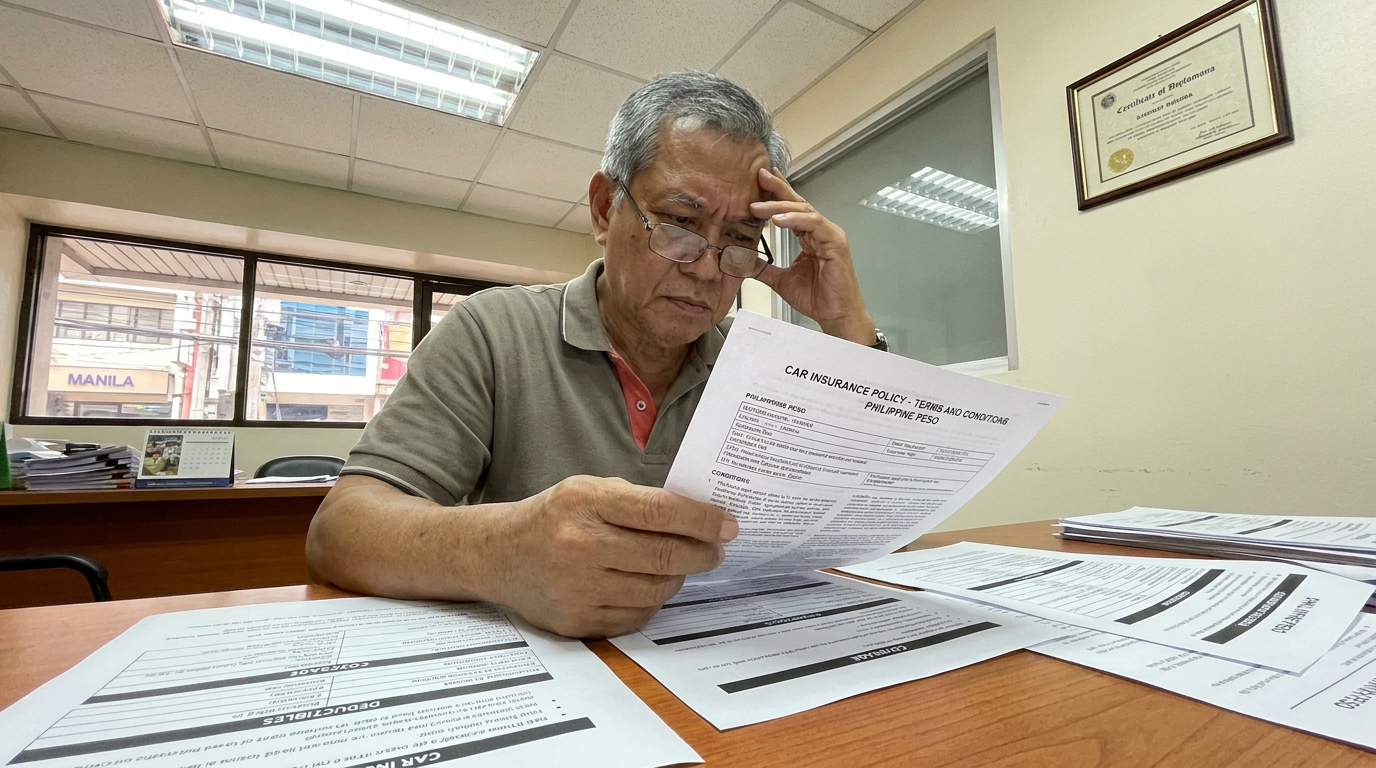
The challenge for most policyholders is that exclusions are typically written in dense legal language and buried in the middle of a 20-page policy document that most people never read. By the time they discover an exclusion, it is usually because a claim has already been filed — and denied.
The Most Common Motor Car Insurance Exclusions in the Philippines
Here are the exclusions that most frequently result in denied claims for Filipino car owners:
🚫 1. Driving Under the Influence (DUI)
If you are driving under the influence of alcohol or illegal substances at the time of an accident, your insurer will almost certainly deny the claim in full. This applies even if you were not solely at fault. DUI exclusions are non-negotiable across all providers and are clearly supported by Philippine law under Republic Act No. 10586 (Anti-Drunk and Drugged Driving Act).
🚫 2. Unlicensed or Invalid License Driver
Your policy covers your vehicle when it is driven by a person with a valid, appropriate driver's license. If the driver at the time of the incident had an expired license, a restriction-code mismatch (e.g., driving a vehicle beyond their licensed restriction), or no license at all — including a family member or household staff member who borrowed the car — the claim may be voided entirely. This is one of the most common reasons for denial and one of the easiest to prevent.
🚫 3. Unauthorized Use — Private Vehicle Used as TNCs/Delivery
Your motor car insurance policy covers the vehicle for its declared use at the time of application. If you declared your car as a "private vehicle" but were actively using it as a ride-hailing service (Grab, inDrive, or any TNVS-accredited platform) or for commercial delivery at the time of the incident, your claim can be denied in full. TNVS operators need a specialized TNVS Secure policy — regular comprehensive insurance does not cover commercial transport use.
🚫 4. Mechanical, Electrical, and Wear-and-Tear Breakdown
Motor car insurance is not a vehicle maintenance warranty. If your engine fails, your transmission breaks down, or electrical components malfunction due to age, neglect, or normal wear and tear, these are excluded. Insurance covers sudden, accidental physical damage — not the gradual deterioration of vehicle components. Breakdown coverage, if needed, must be obtained separately through roadside assistance programs or extended warranty products.
🚫 5. Depreciation Deductions on Older Vehicles
Unless you purchased a policy on an "agreed value" or "market value" basis that accounts for your specific vehicle condition, most standard policies apply depreciation schedules to claims settlements. This means the repair or replacement cost you receive may be significantly less than the actual out-of-pocket expense, particularly for vehicles that are more than three years old. Understanding how your policy values your vehicle before a loss is critical — not after.
🚫 6. Intentional Damage
Any damage caused deliberately by the policyholder, or caused with the policyholder's knowledge or consent, is excluded. This is a standard anti-fraud provision found in all insurance contracts worldwide and is strictly enforced by the Insurance Commission of the Philippines.
🚫 7. War, Terrorism, and Nuclear Events
Damage arising from acts of war, armed insurrection, terrorism (in many policies), and nuclear or radioactive events are excluded from standard motor car insurance. Special endorsements for some of these risks may be available from certain insurers at additional premium.
The Acts of Nature Gap: A Critical Issue for Filipino Drivers
This deserves its own section because it is uniquely consequential in the Philippine context. The Philippines is hit by an average of 20 typhoons per year. Flooding affects low-lying communities across Metro Manila, Central Luzon, and other major population centers every rainy season. And yet — Acts of Nature (AON) coverage is NOT automatically included in all motor car insurance policies.
A standard CTPL (Compulsory Third Party Liability) policy covers bodily injury and death to third parties only — it provides zero coverage for damage to your own vehicle under any circumstances, natural disaster or otherwise. Even comprehensive insurance policies may not automatically include Acts of Nature coverage; it is often offered as an optional endorsement (add-on) that must be explicitly included and paid for.
What does this mean in practice? If your car is damaged or destroyed by flooding during a typhoon, and your policy does not explicitly include AON coverage, your insurer will deny the claim — even if the vehicle is a total loss. This has happened to thousands of Filipino car owners during major flooding events, including the recurring floods in areas like Marikina, Malabon, and parts of Bulacan.
Practical rule of thumb: If your vehicle is parked outdoors, in a flood-prone barangay, or in areas regularly hit by typhoons, Acts of Nature coverage is not optional — it is essential. Always verify explicitly that your policy includes it before typhoon season begins.
Practical Steps to Protect Yourself from Coverage Gaps
Knowing about exclusions is only useful if you take action to address them. Here is what you can do:
Read the Exclusions Section Before Signing
Ask your insurance agent to walk you through the exclusions section of the policy before you accept coverage. A good agent should be able to explain each exclusion in plain language. If they cannot, or are unwilling to, that is a warning sign.
Ask About Endorsements and Add-Ons
Many exclusions can be addressed through policy endorsements. Acts of Nature, personal accident coverage for passengers, loss of use, and roadside assistance are all examples of common add-ons that can significantly improve your protection. Ask specifically what endorsements are available for your policy.
Declare Your Vehicle's Actual Use Accurately
Always accurately declare how your vehicle is used when applying for insurance. If you plan to use your car for deliveries or ride-hailing part-time, disclose this and get the appropriate coverage. Misrepresentation — even unintentional — gives insurers grounds to void your entire policy at the worst possible moment.
Review Your Policy at Every Renewal
Your circumstances change. If you moved to a flood-prone area, started lending your car to a family member, or changed how you use the vehicle, your coverage needs have changed too. Don't just auto-renew — review and update your policy annually.
Work With an Independent Insurance Advisor
A tied agent who represents only one insurance company can only offer you that company's product, with that company's exclusions. An independent agency can compare policies from multiple insurers and find the policy with the most comprehensive coverage for your specific situation — not just the cheapest premium, but the best actual protection.
The Bottom Line: Know Before You Need It
Motor car insurance in the Philippines is not a simple commodity purchase. The right policy for your vehicle, your location, your usage habits, and your risk profile requires careful evaluation — and that evaluation must include a clear-eyed look at what each policy does not cover.
The good news is that most coverage gaps are addressable, either through choosing a more comprehensive policy from the start or by adding the right endorsements. The key is knowing about these gaps before an incident occurs — not after you are sitting in a flooded car watching your insurer's claims team review the fine print.
Take the time to understand your policy. Ask the hard questions. And work with an advisor who will answer them honestly — one who is more concerned with finding you the right coverage than closing the next sale.
Get a Free Quote Today
Ready to protect what matters most? Our insurance experts are here to help you find the right coverage at the best price.
🌐 www.onenetworxinsurance.com
About the Author
Angelo Villamejor is a former financial wealth branch manager at a top Philippine life insurance company and a GAMA Awardee, with nearly three decades of experience spanning insurance brokerage, bancassurance, non-life and life insurance leadership. He leads OneNetworx Insurance Agency with a focus on giving Filipino families and businesses unbiased, expert guidance to find coverage that holds up when it matters most.